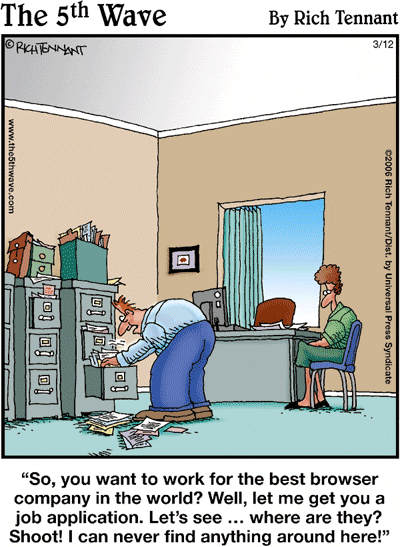
I enjoy using Opera – and personally I think Opera ASA is the best browser company in the world. I’m sure not everyone agrees with me – but I don’t know who Rich Tennant, the cartoonist of the 5th wave have in mind…
My thoughts and whatever about random topics.

I enjoy using Opera – and personally I think Opera ASA is the best browser company in the world. I’m sure not everyone agrees with me – but I don’t know who Rich Tennant, the cartoonist of the 5th wave have in mind…
Well – not according to MSN, that is. At least, not enough.
There is a competition at MSN, where you can win MP3 players or an XBox 360 Core. It could be fun to try, I thought, and browsed over to the website to check it out. it looked nice – except for one box, where the technical specifications for being able to participate were listed up:
The browser failed? Is Active-X required then? But no, the definition of a compatible browser was listed below: “You need a browser that are in accordance with W3C, for example Internet Explorer 5 or higher, Netscape 6.1 or higher, Firefox or Safari.”
Now – I’m really curious of where exactly Opera is not in accordance with W3C – because MSN doesn’t block Opera needlessly on purpose, do they? Though, it wouldn’t be the first time…

72 bands may be hidden in the Virgin-picture, but it’s an idea that was to good to be left alone – so why not repeat it?
In this image, 37 names of Brazilian music are hidden.There are bands and artists, operating or extinct, of the rock to funk music.
I can’t say I’m particulary knowledgeable of the Brazilian music scene, but this makes me curious. So if anyone knows of any names hiding in the picture, please comment. 🙂
A technical preview of Opera 9 has been available for download for a while now, teasing us with some of what we can expect. Many have downloaded it,and use it as their primary browser (despite warnings from Opera that it’s an unfinished product, and as such do contain bugs.) But remember: This is a preview. A taste of what we can expect – not all of it. So, what more will we get?
Operawatch broke the news that widgets will be included – small browser windows that display information taken from the Internet on a user’s desktop. Much like the Dashboard in OS X on the Mac. To get it started, around 10 widgets will be provided by Opera, according to CNET, but anyone can make new ones.
Also new will be thumbnails of the pages. These will appear when you hover over the tabs, for easy recognition of what it is. This is similar to what IE7 will provide.
We also will see the return of bittorrent in Opera 9. This was a much loved feature in an earlier technical preview, so this will be welcome news for many. In addition, Opera will provide access to the bittorrent search engine through the browser interface.
But when can we expect to get our hands on it? According to the just released pressrelease from Opera ASA about bittorrent inclusion, technical preview 2 will be released soon (tomorrow at Tuesday, it sems, and according to the CNET article the final release will be at the end of June.)
If we listen to RIAA, it sounds like the only sensible stance to take against piracy and file sharing is to sue your own customers, and with the exception of several of the artists themselves, this seems to be the view of the rest of the music business, too. Except – it’s not so.
Canadian artist label and management company Nettwerk Music Group has joined the fight against the RIAA on behalf of consumers who wish to download music. This happens after RIAA sued a man for alleged file sharing of 9 tunes, including one by Avril Lavigne, a Nettwerk Management client.
“Suing music fans is not the solution, it’s the problem,” stated Terry McBride, C.E.O of Nettwerk Music Group.
I wonder if RIAA will ever see it this way…
While Opera users sometimes find sites that discriminates them due to bad browser sniffers, the music site eMusic seems to make its own twist on the situation: According to this article on about.com, eMusic presents different offers depending on which browser you use, and which OS. Opera users get the best offer, and Firefox users the least.
How long will this situation last, now that it’s brought forward in the news? No idea. Maybe I should go and have a look? With Opera, of course.
Hmmm – just had a look. I didn’t get such a good offer as the article writes about, so it may be changed already – but I haven’t tested with other browsers.
UPDATE: It seems to be completely random after all, not dependent on which browser you have. I just saw the same thing mentioned on Opera Watch, and the comments there show very different results.
New versions and updates of the good browsers seem to appear regulary. This may mean aded features, bigs been ironed out, smoother operation – in short, better browsers. Ideally, these changes should be reflected in at least reviews of the different browsers, which in turn may be a part in forming opinions. The question is then: How up to date are the reviewers?
In the online edition of the Indianapolis Star, I read an article dated yesterday about different alternatives to IE, and how it could be nice to try them and make the switch away from IE. A nice, well-informed article that doesn’t try to claim that a browser switch is the end to all problems. However, there were one little detail about one browser, that stated something wrong.
The browser is Opera, the statement was about the banner ads in the free version, and that to get rid f them you’d have to pay $40. This used to be true, but Opera has been completely free without any banner ads for some time now, so an article dated January 22, 2006 should reflect that. On the positive side, those banners were the only negative things said about the browser, so as they’re gone…
Anyway, I mailed the author a friendly (I hope) little correction, but it made me think a bit more about this: How many people base their opinions of the current version of Opera, based on what they know of a previous version, maybe even a much older version? When we see what people write on discussion forums and in comments on blogs, it may be quite a few. This is why I think it should be important that those who write reviews and articles and such are careful not to get anything wrong – there may be a “the newspaper said it, so it must be correct”-effect.
Maybe it will be easier when Opera 9 is released?
David Byrne is a musician. As a musician, the DRM-schemes are set out to protect his CDs from being pirated, so that he won’t lose any money. Thus, he must love DRM, right?
Well – maybe not. In his journal, he start the latest entry by encouraging us to not buy CDs from the Big 5, because of DRM. Doesn’t sound like he’s too fond of DRM, does it? Quite the opposite, he thinks that it ruins everything for everyone, and ponders about the record companies:
So, first they start off suing their customers, and now they are maliciously making it hard for their customers to even listen to music, and they will cripple your music and media player to boot. These guys deserve to go out of business, they obviously don’t love music, and they don’t understand their own customers. They must have a deathwish or be run by….who? FEMA? Rumsfeld? Bin Laden?
Of course, as we’ve seen, he’s not alone in thinking that.
I got to think a bit about this topic after yet another debate about browser statistics, and how Opera may be under represented or not, and how good the statistics programs are at measuring actual use. Well, the one thing that is certain, is that the statistics collected says something about the traffic to those sites, and may give an indication about the traffic to other sites – but what sites are the numbers collected from?
I don’t know what sites are used as basis. I don’t know the location of them either – they could be spread evenly around the world, or mainly in one part of the world. Does it matter? It may.
It’s said that wile Opera doesn’t have that many users in USA, it’s popular in Europe, Russia and Japan. If the web sites that the statistics are collected from are evenly spread around the world, this doesn’t mean anything. However, if the majority of the sites are based in USA, with mainly visitors from USA, then the numbers are skewed.
I set up a small, easy case, completely at random:
There are two areas, A and B, with 100.000 users (of browsers) each.
There are 100 websites, each with 10.000 visits: 10 in area A, 90 in area B.
People visit only the sites in the area where they’re based.
There are 3 browsers: Speeder, Skimmer and Stumbler.
The percentage of users of the various browsers differ by the areas.
I set up a table:
| Area: A | Area: B | Total | |
|---|---|---|---|
| Users | 100.000 | 100.000 | 200.000 |
| Speeder | 10,0% | 1,0% | 5,5% |
| Skimmer | 15,0% | 10,0% | 12,5% |
| Stumbler | 75,0% | 89,0% | 82,0% |
| Web sites | 10 | 90 | 100 |
| Number of visits | |||
| Speeder | 10.000 (10,0%) | 9.000 (1,0%) | 19.000 (1,9%) |
| Skimmer | 15.000 (15,0%) | 90.000 (10,0%) | 105.000 (10,5%) |
| Stumbler | 75.000 (75,0%) | 801.000 (89,0%) | 876.000 (87,6%) |
Now, we see that the statistics collected from the sites show a different percentage of users on the browsers than the actual numbers. Thus, we see it would be necessary to know more than just that number to tell what the statistics actually says.
Had the number of websites used to collect the statistics been evenly spread, with 50 in each area, the statistics would have shown the real usage.
Back in the real world, the interesting question isn’t whether Opera is under counted for some reason, or Firefox over counted, or something like that. The interesting questions are: What sites are used to collect the data for the statistics? Where are they based, and where are their visitors based? Are users from certain areas more likely to use certain browsers than visitors from other areas?
It’s a lot of questions, but necessary to see whether the figures are skewed or not.
DRM is:
Digital Rights Management (Whose rights?)
Digital Restrictions Management (It certainly restrits me from doing what I want with my own property.)
Digital Rights Mismanagement (Now we’re talking about my rights – but not my management.)
Disastrous Rootkit Mistake (Indeed!)
Digital Restraining Methods (That’s the whole point, right?)
Delibrately Ruined Music (The reality.)
Dense, Retarded Mindset (Just to sum it up.)
With the continuing saga of the Sony Rootkit blunder going the rounds on internet and other media, DRM is being scrutinised again. But, what is DRM?
No matter which words we’d like to substitute the letters in DRM with, it’s all about one thing: Control. Not protection from piracy, but control – a lot of control. First of all, it’s control over competitors: If you can control which equipment your music can be played on, or ripped to, you can prevent your customers from using your competitors equipment, be it CD players, mp3 players or whatever. And what do we get then? “You can’t rip our CDs to your mp3 player from our competitor? Too bad – you’d better ask our competitor to fix their stuff then.” Replace relevant words and passages with Sony, iPod and Apple, if you like.
Fun isn’t it, to have to take into consideration which music player you can play which music on? Following the above aspect of DRM to its end, we’d have to buy different equipment to play music from the different providers – and we don’t need too much of an imagination to see how this will be: It’s here already! Buy music from iTunes, and you need an iPod. Buy from a different music store, which provides DRM’ed music in WMA format, and you need a different player. And so on.
Technically, there’s nothing in the way of it all being playable in all players – but there are obstacles put in the way for you and for the competitors. But that’s not all – when you’ve got the music, you’re not allowed to do all what you might like with it. Different DRM schemes varies, restricting you in different ways. You may discover that you can’t make a backup of your music files, that you can’t mix your own party CDs, can’t play in the car stereo, or brand new home entertainment studio – if you’re real unlucky your equipment may even be damaged – sharing with friends are out of question of course, and – well.
What happened to our rights as consumers? They’re soon gone, if this continue. Who will benefit from this? After all, it’s all justified with the artists and how they risk being deprived of their income if there’s no DRM, as otherwise they would be pirated rampantly.
Not all artists see it this way; more and more feel that pissing off their fans – who don’t like DRM – is worse than letting more people learn about their music through sharing for free. Several studies have shown that this usually is an advantage for the artists, and that the sharers buy more music, not less. And artists have experienced renewed interest in their older albums from new fans, due to the sharing.
The exception seems to be the top artists that are heaviy marketed by the music companies.
So if it’s not the artists that benefit from DRM, it may be the record companies? Many seem to think so, and that DRM is a way to hold off the inevitable change that the internet and broadband has brought about, so they can keep their current business model. DRM may help for a while, at the expense of us – the consumers. Because as we see, DRM is a way to let others make decisions on our behalf about what we can do with what we buy (not just music, even if that’s the example here.)
So, what can we do about it? There are two alternatives:
Personally, I’m going with the second option.